

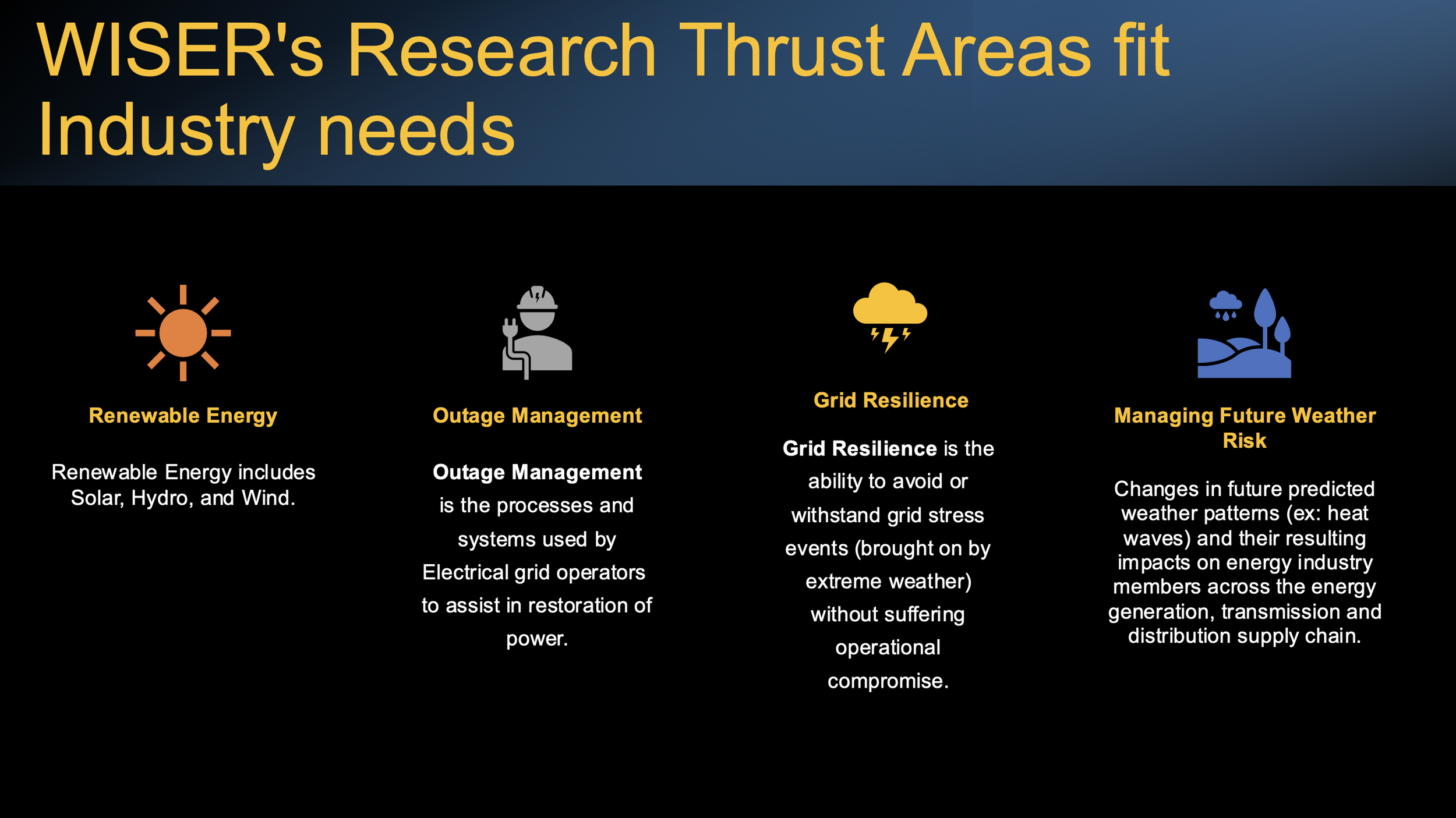
The research directions of WISER are driven by looking closely at the energy sector today. There are various signs that suggest rapid transformation for future developments in the energy industry. Governments around the world pass legislation in order to incorporate sustainable energy sources and technologies to enable the efficient use of energy systems. Broadly, the energy industry trends WISER will be researching fall into four Research Thrust Areas:
Renewable Energy: includes Solar, Hydro, and Wind.
Outage Management: is the processes and systems used by electrical grid operators to assist in the restoration of power.
Grid resilience: is the ability to avoid or withstand grid stress events (brought on by extreme weather) without suffering operational compromise.
Managing Future Weather Risk: Changes in the future predicted weather patterns (ex: heat waves) and their resulting impacts on energy industry members across the energy generation, transmission and distribution supply chain.
WISER will also recruit graduate and undergraduate students from underrepresented groups to increase minority participation in science and engineering and especially interdisciplinary collaborations and exposure to industry-academia partnerships.
University at Albany:
Aerosol Cloud Precipitation
Renewables & Grid Resiliency
Air Quality
Artificial Intelligence
Atmospheric Chemistry
Aerosols Boundary Layer Weather
Climate Synoptic
Mesoscale Meteorology Climate
Environmental Systems Atmospheric Chemistry
Physics Urban Coastal Weather
Combined Capabilities
Weather & Climate Flood Risk Modeling
Urban Coastal Weather
Coastal Engineering and Resilience
Renewables & Grid Resiliency
Offshore Wind Energy Prediction
Artificial Intelligence
University of Connecticut
Power system modeling
Vegetation risk modeling
Flood risk modeling
Extreme weather prediction
Cybersecurity Microgrids
Outage prediction modeling
Grid resilience assessment
Infrastructure integrity modeling
Coastal engineering and resilience
Offshore wind energy prediction